




“Are you more excited about the book or the podcast?”
I’ve had a few friends ask me that question in recent months because, whenever I’m talking about The Lord Is My Light, I keep pinging back and forth between the two. At this point, it’s hard to fully separate the one from the other.
The volume, releasing this week—a handsome, cloth-over-board book with more than 1,400 cream-colored pages—was started in large part because of the vision for a podcast. And yet the podcast (which launches on December 1) follows each daily liturgy word for word. To me, it’s all one project.
How ‘The Lord Is My Light’ Came to Be
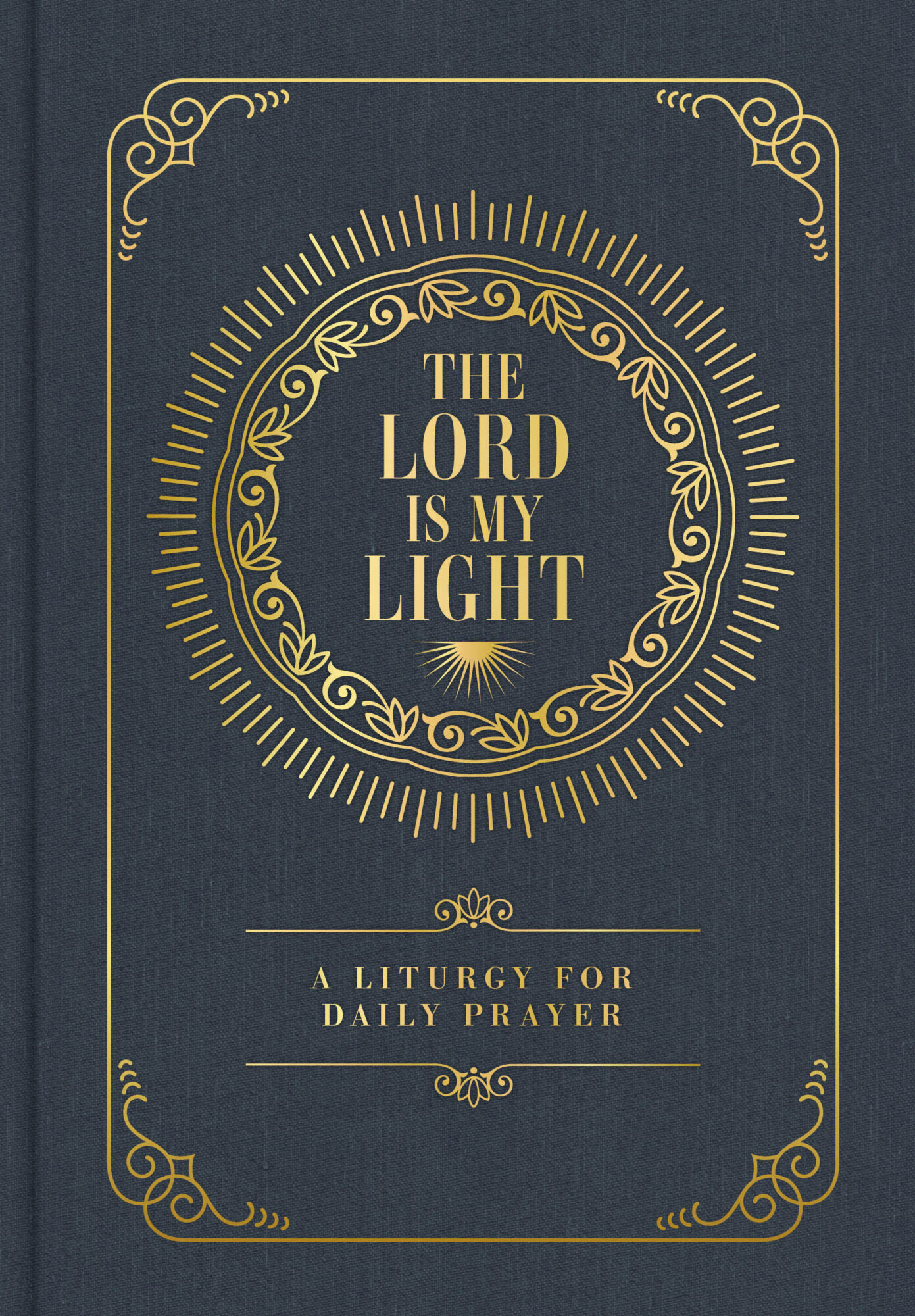 In case you’ve missed me talking about this project, let me bring you up to speed. Back in 2019, I put together a little book that takes readers through all the psalms in 30 days, arranged for three-times-a-day prayer. Next came the Life of Jesus in 30 Days, and then Letters of Paul in 30 Days, both following the same structure for daily prayer. The more people benefited from these prayer books, the more I started fielding requests for a podcast version.
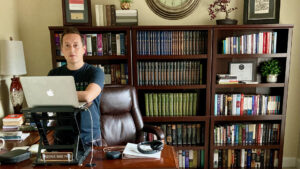
I loved the idea of doing a podcast, but it seemed unwieldy to try to release three episodes a day. What’s more, the kind of podcast I was most interested in wouldn’t be a simple audio companion. I wanted to create an atmosphere of soundscapes—an audio sanctuary that would draw listeners into a sacred space that felt simple, yet otherworldly, with just the right level of ambience and repetition to focus our attention on the Word of the Lord, and to help us join our hearts to the voices praying the words of our forefathers and mothers in the faith.
So, in 2024, I worked on a pilot episode with Scott Slucher and the amazing team responsible for the excellent production of my podcast with the North American Mission Board, Reconstructing Faith. Once the team at Holman heard it, they asked me to put on my liturgist cap and compile daily prayer guides for every day of the year.
What Does ‘The Lord Is My Light’ Daily Liturgy Look Like?
First, I mapped out the main readings for each day of the year, broadly following the outline of the church year, while ensuring every book of the Bible was represented. Once the primary readings were established, I began to surround those readings with additional elements for the daily liturgy, working to keep each day close to the same length and making choices that would align with various biblical themes.
Here’s the pattern for every day.
Call to Prayer
Each day begins with a biblical truth or expression of praise, taken directly from a verse of Scripture or from a traditional call to worship, corresponding thematically to the season of the church year or the daily reading.
Confession of Faith
Next, you recite a passage of Scripture, an ancient creed, a portion of an older confession, or the words from a contemporary statement of faith.
The two creeds most often presented are the Apostles’ Creed and the Nicene Creed. The scriptural passages, creedal in design, include the ancient Hebrew confession of faith called the Shema (Deut. 6:4–5), the apostle Paul’s announcement of the resurrection (1 Cor. 15:3–6), his hymns celebrating the identity and exaltation of the Son of God (Phil. 2:6–11; Col. 1:15–20), and his “trustworthy saying” about the ascended Lord (1 Tim. 3:16).
I include lightly contemporized selections from the confessions and catechisms of the Reformation and post-Reformation era: the Belgic Confession (1561), the Heidelberg Catechism (1563), the Second London Baptist Confession (1689), and the New Hampshire Baptist Confession of Faith (1833). Also featured are the Protestant affirmations that make up the Reforming Catholic Confession, a beautiful summary released in 2017 in commemoration of the 500th anniversary of the Reformation.
As for contemporary expressions of faith among global evangelicals, you’ll encounter the Lausanne Covenant (1974), the Cape Town Commitment (2010), and the Seoul Statement (2024).
Confession of Sin
The confessions of sin that most often recur come from The Book of Common Prayer, including a lightly contemporized form of Thomas Cranmer’s well-crafted 1552 confession. Other expressions of repentance come from Scripture (Ps. 51:1–2), the Jesus Prayer (adapted from Luke 18:13), or ancient cries for mercy (Kyrie eleison, Agnus Dei).
Other confessions of sin are also featured: the fourth-century Liturgy of Jerusalem and St. James, several Puritan prayers from The Valley of Vision, and the words of a wide range of influential church leaders throughout Christian history (Clement of Rome, Ambrose, Gregory of Nazianzus, Augustine, Bucer, Bullinger, Wilberforce, etc.). After every confession of sin comes a verse of Scripture intended to assure the repentant heart of God’s love and pardon.
Canticle
Next comes a hymn or song, typically taken from or inspired by the Scriptures. Not surprisingly, the psalms make up the largest selection of canticles, and I’ve included at least a portion of all 150 psalms.
You’ll also find additional scriptural poems and songs, including those from the prophets, especially Isaiah. Several scriptural songs that show up frequently are Mary’s and Zechariah’s songs of praise from Luke 1 and the songs of the Lamb from Revelation. A couple ancient hymns from church history also appear (the Te Deum and the Sanctus).
Often, the canticles will align thematically with the reading for the day, to bring to the surface the intertextual connections in the Scriptures. For example, a song of restoration from the prophets may precede a reading where Christ’s ministry brings about an initial fulfillment of God’s promise. Or a psalm of David may precede or follow a moment in his life that prompted its composition.
Reading
The readings don’t cover every word of the Bible, but they do feature selections from every scriptural author, so that in the scope of one year, the full chorus of all the inspired writers of God’s Word can be heard.
I’ve used the Christian Standard Bible translation. The design of readings follows, generally, the season of the church year, yet I’ve often linked the readings thematically with other elements of this liturgy, so the intertextual connections between the Old and New Testaments are made clear.
Gloria & The Lord’s Prayer
After listening to God’s Word, you give glory to our triune God—Father, Son, and Holy Spirit—now and throughout all eternity. Then, you pray as our Lord Jesus instructed.
Intercessions and Personal Requests
Every day’s liturgy offers a time to pray spontaneously about whatever is most on your heart and mind. Sometimes, this moment will be marked most by praise. Other times, it may be deep lament.
You can intercede for our family and friends, for those in your church, for missionaries and workers in far-flung lands. You can ask for the Lord’s guidance in the day ahead, for wisdom in the decisions you make, for the healing of those you know who are sick.
It may be helpful to keep close a set of cards where you make a list of people you’ve committed to praying for. This time of personal intercession can be as short or long as you need it to be.
Prayer of the Church
The prayers of the church come from a wide variety of sources. Here you’ll encounter our forefathers and mothers in the faith—from the earliest Christians like Clement of Rome, to African church fathers like Athanasius and Augustine, to medieval voices like Anselm, to reformers like Martin Luther, and to preachers like Charles Spurgeon.
You’ll find a range of voices, from the martyr Anna of Freiburg, to the novelist Jane Austen, to the social reformer William Wilberforce, to the missionary Amy Carmichael, to the slave-turned-church-founder Richard Allen.
I’ve lightly adapted and updated these prayers for contemporary use. My hope is that curiosity about the names and dates included here will lead you to learn more about those whose prayers have been passed down to us.
Blessing
The liturgy concludes with a blessing taken from Scripture, an expression of hopeful promise for the Lord to work in and through us.
These daily liturgies provide intentional repetition from week to week, often returning to the same canticle or confession of faith multiple times throughout the year, or repeating a particular confession of sin every couple of weeks or once a month. This repetition is meant to encourage memorization. At the same time, the variety is meant to keep you engaged so you don’t fall into merely rote recitations.
Finding the right balance between familiarity and freshness is more an art than a science. My aim has been to provide a fixed order, designed for a familiar flow of elements, and a variety of prayers and readings to keep the experience fresh.
Several have asked if this can be used for family devotions. The answer is yes! There are instructions in the introduction for how to adapt this daily liturgy for family or church use.
‘The Lord Is My Light’ Podcast
 I’m so thankful for the 100-plus people who have lent their voices to the podcast version. We’ve enlisted contributors from across the country and around the world—various regional accents and tones, pastors and laypeople, young and old, men and women, singers and songwriters. Some are names you’d recognize, but no one is seeking credit or attribution.
I’ve asked every participant to not just recite the words aloud but actually address God, so that the recording captures a genuine act of speech directed to God. For my own portions, we’ve recorded a fresh version for every single day—no copying from previous sessions.
Scott Slucher and his team have focused on the sonic experience of the podcast. Each episode will open with a familiar melodic line from an ancient hymn suited to the season of the church year. (For example, “O Come, O Come, Emmanuel” during Advent, “Joy to the World” during the 12 days of Christmas.)
Then we settle into an ambient soundscape that supports the flow of the liturgy. The Scripture reading for the day is set apart with no background music at all, because we want to heighten the stillness of hearing only God’s Word during those minutes. The result is a 10–12-minute audio sanctuary.
Join Us!
The Lord Is My Light as a printed volume begins shipping any day now (and with some retailers has already shipped!). You can order it wherever books are sold, and you begin with whatever the liturgy is for the day you receive it.
For the podcast, you can go ahead and listen to the trailer and subscribe. (Check it out on Spotify or Apple.) Beginning December 1, a new episode will release every day.
I pray you’ll receive this daily liturgy as a gift. These prayers and Scriptures intend to help you place yourself before God, day after day, with open hands. We trust that God, by his Spirit and the power of his Word, will shape us into people who rest in his grace, pray in the truth, and walk in the light as he is in the light (1 John 1:7).
If you would like my future articles sent to your email, as well as a curated list of books, podcasts, and helpful links I find online, enter your address.